
When Does Japan’s Cherry Blossom Season Peak?
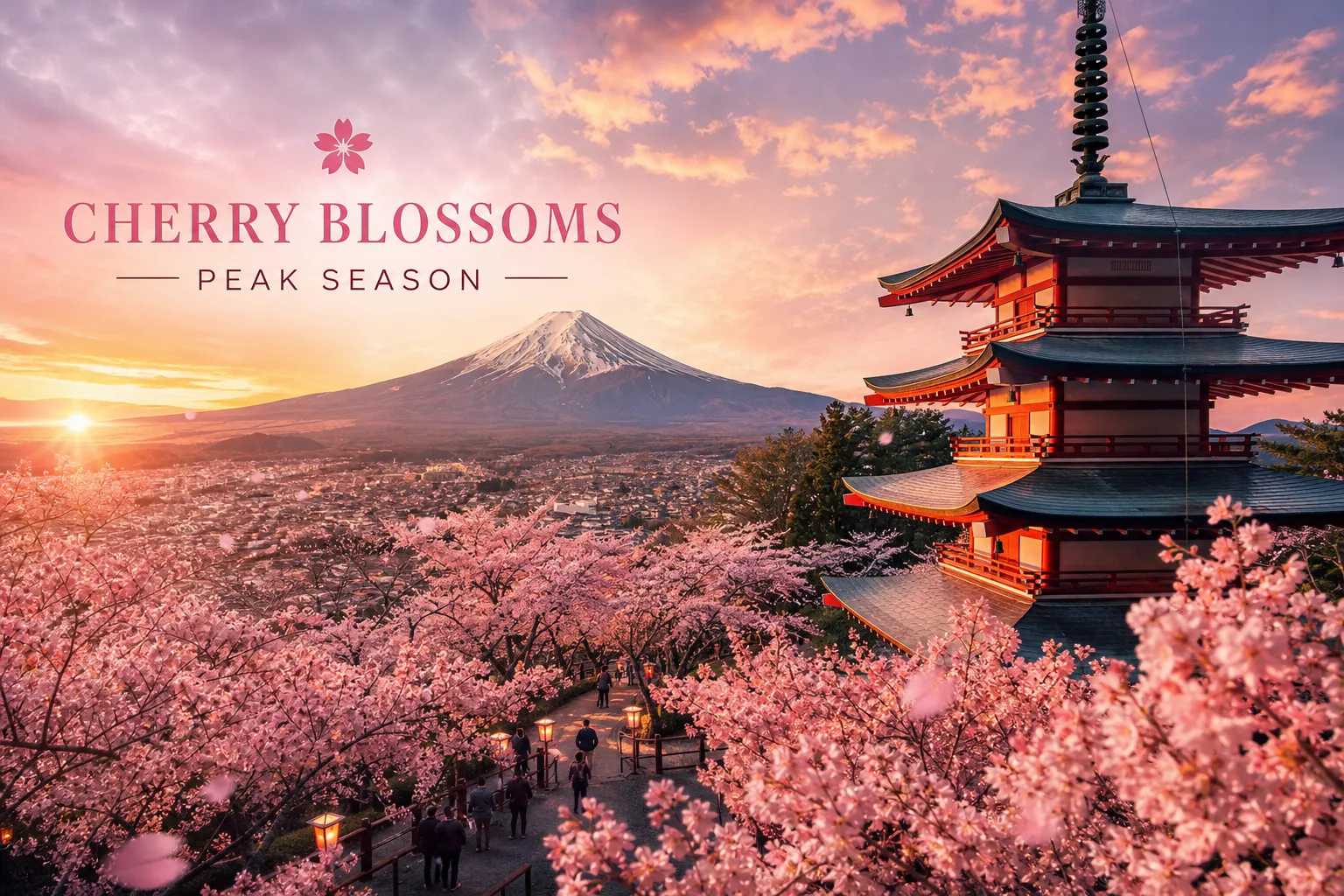
There’s a particular kind of magic to standing beneath a canopy of sakura in full bloom during Japan’s cherry blossom season, soft petals drifting over stone paths, the air carrying that unmistakable scent of spring.What makes it extraordinary, and honestly a little nerve-wracking, is how brief it is. The peak window lasts five to seven days. Miss it by three, and you’re either too early (bare branches) or too late (a carpet of fallen petals and very disappointed travellers).
Japan’s cherry blossom season isn’t a single event on a single date. It’s a rolling, northward progression that unfolds over six to eight weeks, shifting from Kyushu’s warm coastlines up through central Honshu and eventually reaching Hokkaido’s parks in late April.Many seasoned Japan travellers now plan their entire itineraries around the bloom forecast first and lock everything else in second. That approach is exactly right. This guide will show you how to do the same.
How Japan’s cherry blossom season progresses: the sakura front
The sakura zensen, or sakura front, is a northward-moving bloom line tracked by Japan’s weather agencies each year. It begins in the subtropical south and moves steadily upward, driven by rising spring temperatures.
The front progresses gradually from region to region, which means a well-structured itinerary can follow the bloom across Japan and potentially extend your viewing window from a single week to three or four.
Understanding this progression is the single most useful piece of planning knowledge you can have before booking a Japan trip around sakura.
Japan’s weather agencies publish a cherry blossom forecast, updated several times through the season, along with a sakura front map showing the bloom line’s expected position at any given point in time. Both the Japan Weather Association (JWA) and JMC release these tools from late January onwards, and checking them regularly is the most reliable way to time your travel.
From Kyushu to Hokkaido: the regional sequence
Kyushu opens the mainland season in mid-to-late March, with Fukuoka typically among the first major cities to reach full bloom.
Central Honshu follows through late March and into early April, covering the heavy hitters: Tokyo, Kyoto, Hiroshima, and Osaka.
Northern Honshu and the Tohoku region bloom through mid-April, offering a quieter, often overlooked alternative for travellers who’ve missed the central peak.
Hokkaido arrives last, with Sapporo typically reaching full bloom around the final week of April.
2026 peak bloom dates: a retrospective guide
The 2026 Japan cherry blossom season was earlier than average in many regions, although the timing varied considerably between destinations.
Based on forecasts from the Japan Weather Association and JMC, the full-bloom (mankai) dates for the major cities were as follows:
- Tokyo: March 28
- Kyoto: March 30
- Hiroshima: March 30
- Osaka: April 3
- Fukuoka: April 3
- Sapporo: April 24
Full bloom is declared when 80 per cent or more of flowers on the reference tree have opened. From that date, you typically have five to seven days of peak viewing before rain or wind accelerates petal fall.
That narrow window is why arrival timing matters so much, and why the booking strategy that follows is worth understanding well ahead of the 2027 season.
Planning ahead for the next sakura season? Explore our range of Japan cherry blossom tours and experiences for 2027.
The cherry blossom varieties that quietly extend your season
Most travellers plan around Somei Yoshino, the pale-pink variety that makes up roughly 90 per cent of Japan’s trees. It blooms in a spectacular, near-simultaneous rush across the country, which is precisely what makes it so dramatic.
What many travellers don’t realise is that other varieties create a staggered season stretching from January all the way through to May.
Early bloomers worth planning around
Kawazu-zakura, a rich deep-pink variety native to the Izu Peninsula, blooms from mid-February. It’s a striking contrast to the pale wash of Somei Yoshino and draws far smaller crowds.
Further south, Atami-zakura flowers along coastal hot-spring towns from January, and Hikan-zakura blooms in Okinawa from as early as mid-January.
These varieties let you experience cherry blossoms weeks before the main season begins, well ahead of the peak-season crowds in central Japan.
Yaezakura and the second wave
Yaezakura is a multi-petalled, deeper-pink variety that blooms later than Somei Yoshino, often during mid-to-late April in cities like Tokyo and Kyoto, depending on the variety and seasonal conditions.
This makes it a genuinely useful option for travellers whose schedules don’t align with the late-March peak, or for those who want a hanami experience without the shoulder-to-shoulder crowds that descend on Ueno Park and Maruyama in early April.
The second wave is quieter, the trees are fuller-looking, and the season feels almost private by comparison.
The best places to see cherry blossoms, away from the crowds
The famous spots are famous for a reason. Ueno Park in Tokyo, Maruyama Park in Kyoto, and Osaka Castle draw genuinely stunning concentrations of sakura.
They also draw large crowds and lively groups gathering on picnic sheets beneath the trees and the kind of shoulder-to-shoulder hanami that feels less like a cultural experience and more like a festival queue.
The better question isn’t where the famous spots are. It’s where you’ll actually want to be.
Tokyo: the alternatives that deliver more
Shinjuku Gyoen is a strong first choice: a large, well-maintained garden with a pleasing mix of varieties and stricter picnicking rules than most parks, which keeps the atmosphere far more relaxed than Ueno on a Saturday afternoon.
During the 2026 peak season, advance reservations were required during selected hours on certain dates, a policy worth checking on the official Shinjuku Gyoen site when planning for 2027.
The Meguro River walk offers something the parks don’t: the sensation of petals floating over water on both sides as you move through a tree-lined corridor.
Chidorigafuchi is worth the early start for the rowboat experience along the moat, drifting beneath a canopy of overhanging blossoms as petals fall around you.
Kyoto and further north: where the scenery earns the journey
The Philosopher’s Path in Kyoto runs along a canal beneath cherry trees and draws far fewer visitors than Maruyama, particularly in the early morning or after dark.
For travellers willing to head north, Hirosaki Castle in Aomori (peak bloom typically mid-to-late April) is one of Japan’s most photographed sakura settings.
The castle’s moat fills with fallen petals, creating a pink reflection that’s genuinely unlike anything in the south, and it serves as a useful safety net for travellers who’ve missed the central Honshu peak entirely.
Sapporo’s Moerenuma Park, designed by Isamu Noguchi, offers Hokkaido’s late-April bloom in a striking landscape setting that few Australian travellers think to seek out.
For more suggestions on quieter viewing spots across Kyoto and beyond, this round-up of less crowded cherry blossom locations is a useful resource: best places to see cherry blossoms away from the crowds.
Experiencing Japan’s cherry blossom season in luxury: ryokans, private gardens and invite-only hanami
Public hanami offers a lively and distinctly Japanese way to experience the season, with parks filled with families, friends and travellers gathering beneath the blossoms. For those seeking something quieter, private gardens, luxury ryokans and seasonal dining can offer a more intimate perspective.
Picture a secluded garden, a beautifully presented kaiseki meal and an unhurried view of the blossoms away from the busiest crowds. Creating that kind of experience comes down to thoughtful planning, careful timing and access to the right local partners.
Why a luxury ryokan changes the entire experience
A well-placed ryokan in Kyoto or Nara may offer the opportunity to wake up to cherry trees in a private courtyard before the city has stirred.
Hiiragiya and Tawaraya in Kyoto are both known for their traditional garden settings, making them particularly sought-after during sakura season. Room views and private garden access vary and should be confirmed when booking.
What to look for: ryokan with garden-facing rooms, onsen with sakura views, and in-house kaiseki menus built around seasonal spring produce.
The best properties can book out six to twelve months ahead during sakura season. If you’re planning for 2027, that booking window is already open now.
Speak with a Gallivanter Travel advisor for help choosing a ryokan that suits your preferred location, style of stay and cherry blossom itinerary.
Invite-only hanami and private tea ceremonies
This is where the experience moves from beautiful to genuinely story-worthy.
Haradani-en in Kyoto is a private garden open for only a limited period each year, featuring rare weeping sakura in a setting that no public park can replicate.
Depending on the year, availability and property arrangements, luxury hotels such as Hoshinoya Kyoto and Aman Tokyo may offer curated seasonal experiences for guests, including guided blossom viewing, river outings or night-viewing excursions.
Depending on availability and your itinerary, the team at Gallivanter Travel can explore options such as private garden visits, hosted hanami experiences and private tea ceremonies through our Japan travel partners.
These experiences are not always available through standard booking platforms and may depend on seasonal access, supplier relationships and local conditions.
For travellers who want sakura without compromise, having an experienced advisor coordinate these experiences around the latest bloom forecast, rather than an assumed date, can help create a more considered and memorable journey.
How to track the bloom and book without gambling on the forecast
Sakura forecasts are released from late January onwards and updated regularly through the season.
The final dates can shift from the initial prediction, which means locking in non-refundable arrangements months ahead based on an early forecast carries real risk.
A clear monitoring strategy removes most of that uncertainty.
The forecast tools worth checking
The Japan Weather Association (jwa.or.jp, published via tenki.jp) releases its cherry blossom forecasts in stages from late January through to early April.
JMC (Japan Meteorological Corporation) publishes an initial forecast and updates it regularly through the season.
Both use designated reference trees at observation sites across the country, and both publish sakura front maps showing the bloom line’s expected progress.
Full bloom is confirmed when 80 per cent or more of flowers on the reference tree are open.
Beyond the official dates, watch daily weather closely: rain and wind can shorten a peak bloom period to less than a week.
How far ahead to book and what to do if dates shift
For peak season in Tokyo and Kyoto (late March to early April), accommodation should be secured six to twelve months in advance.
Flights from Australia fill quickly, particularly direct services on JAL and ANA.
One possible itinerary strategy for Australian travellers is to begin in Fukuoka and travel east and north toward Tokyo, potentially creating a wider viewing window across the progression. However, the ideal direction varies each season and should be based on the latest forecast rather than an assumption that Fukuoka will always bloom first.
Working with an advisor who monitors the live forecast and adjusts on-ground arrangements where availability and booking conditions allow can reduce some of the guesswork.
Start planning your Japan cherry blossom season before the window closes
Japan’s cherry blossom season rewards preparation in a way that few travel experiences do.
The window is short, the reward is extraordinary, and the difference between a trip you’ll treasure and one you’ll quietly regret is almost always timing.
Know the sakura front. Study the cherry blossom forecast for your target year. Identify the right region for your travel window. Consider the variety-staggering strategy to extend your time with the blossoms.
And if your dates don’t allow for the main season, Tohoku’s mid-April bloom and Hokkaido’s late-April parks offer a beauty that central Japan’s crowds can’t touch.
Luxury adds a layer of access that fundamentally changes what sakura season feels like. From a public park in the rain to a private garden at golden hour, the distance between those two experiences is the advisor you choose to work with.
For travellers who want their hanami experience to be as considered and story-worthy as the destination deserves, the team at Gallivanter Travel is the place to start.
Plan your Japan cherry blossom season with an advisor today. Reach out, tell us your dates, and the team will build the rest around the bloom.
For a more general primer on timing, etiquette and what to expect when visiting during sakura season, our in-depth guide is a handy companion: Sakura Season: A Guide to Japan’s Cherry Blossoms.